
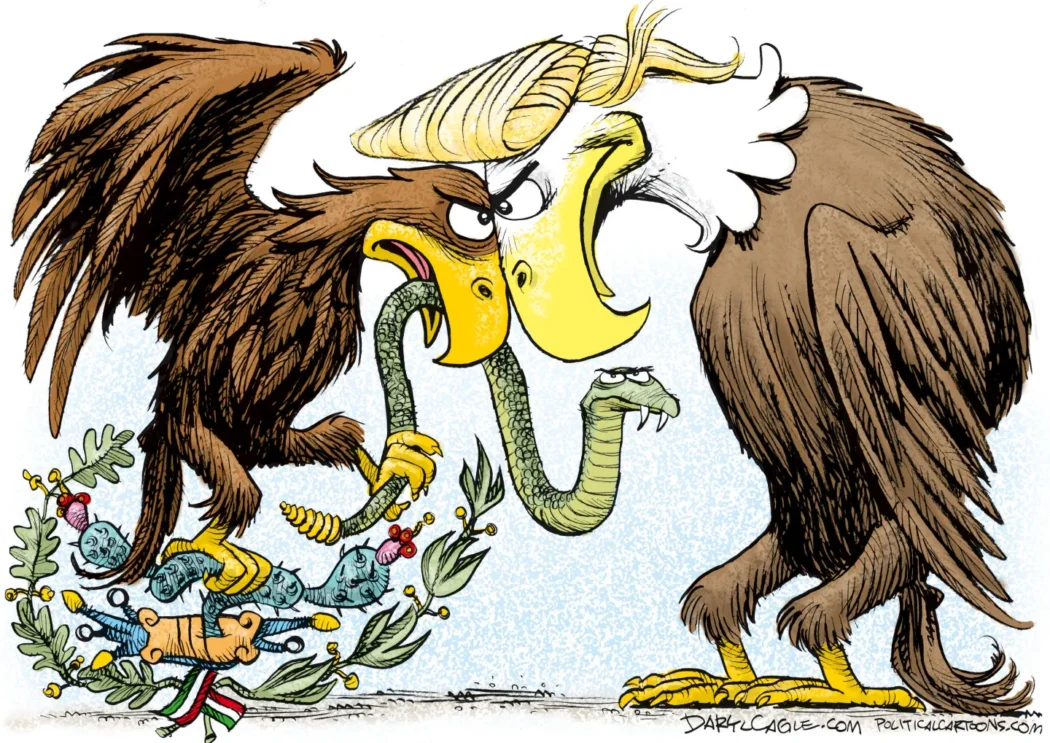
On Feb.1, President Trump implemented a set of tariffs on Canada, Mexico and China in response to rising tensions over fentanyl trafficking and immigration.
On Feb. 3, Mexico announced a series of retaliatory measures that caused the Trump administration to postpone the 25% tariff. Canada declared similar measures and was then granted the same respite later that day
President Trump announced he would halt the import levies on goods from Canada and Mexico for at least one month to allow for negotiation between the countries.
Despite this, tariffs on Chinese imports began at a 10% additional tariff on top of the existing dues currently applied to many Chinese goods.
Understanding Tariffs
A tariff is a tax on imported goods, usually as a percentage of the product’s value. The value of a product is determined by how much an independent buyer would be willing to pay for something from an independent seller.
For example, for an item subject to a 10% tariff, the importer will need to pay an additional $10 for the goods.
Who Pays the Cost?
Under U.S law, the importer is responsible for paying the tariff; however, it is typical for the price on tariffed goods to increase to allow for a larger profit margin for the distributor.
For example, crude oil from Canada that is piped into the US to be refined into gasoline would have a 10% tariff. If priced at $75 a barrel, there would be an additional $7.5 charge to import the oil into the U.S.
Oil has an incredibly small profit margin—this additional charge could lead to higher gas prices for consumers as distributors pass on the extra cost.
“BP is not going to absorb any part of the additional $6 or whatever it is”- David A. Gantz, Will Clayton Fellow in Trade and International Economics at Rice University
Similar to gasoline, items like perishable vegetables may be at risk of price hikes. Items like children’s toys, cosmetics and footwear have high-profit margins that could withstand the additional cost the tariff has in importing the product.
Why Use Them?
Historically, tariffs were used as the primary source of revenue for the federal government until 1913 when federal income tax began.
At their highest, tariffs accounted for approximately 90% of the federal government’s revenue. Once the effects of income tax set in, that percentage fell to 30.1% after the start of the Civil War in 1915.
Tariffs have steadily declined in their contribution toward federal revenue. Over the past 70 years, tariffs have never accounted for more than 2% of revenue. In 2024, their contribution was 1.5% which amounted to about $77 billion in collected duties.
Reciprocal Tariffs
President Trump’s administration has threatened to extend tariffs to other nations to address trade imbalances.
During a Feb.7, meeting with Japanese Prime Minister Shigeru Ishiba, Trump reiterated that reciprocal tariffs would be imposed on various countries soon.
President Trump has remained steadfast in targeting the auto industry as European Union (EU) tariffs on car imports are exceedingly higher than US levies.
Reports indicate that Trump could act on these tariffs “pretty soon” while a potential deal with the UK could alter the trajectory of the EU trade dispute.
The Path Forward
As tensions rise, many question whether the ongoing trade wars will result in meaningful agreements or leave the global economy in a state of perpetual conflict.
Will Trump’s tariff strategy truly “level the playing field” or will it simply exacerbate existing economic challenges?
Let us know your thoughts by tagging us @VALLEYmag on X.
Related
U.S. Under Scrutiny For Treatment of Deportees
Assad Regime Topples in Syria
Trump’s Executive Orders: The Impact on Penn State





An impressive share, I simply given this onto a colleague who was doing a little bit analysis on this. And he in truth purchased me breakfast because I discovered it for him.. smile. So let me reword that: Thnx for the treat! But yeah Thnkx for spending the time to debate this, I feel strongly about it and love studying extra on this topic. If doable, as you grow to be expertise, would you thoughts updating your blog with more details? It’s extremely useful for me. Huge thumb up for this weblog submit!
I was recommended this blog by my cousin. I’m not sure whether this post is written by him as nobody else know such detailed about my difficulty. You are wonderful! Thanks!
I’ve been absent for a while, but now I remember why I used to love this web site. Thank you, I will try and check back more often. How frequently you update your web site?
I believe you have noted some very interesting points, appreciate it for the post.
Wah! Blog ini terlihat persis seperti blog lama saya! Topiknya sangat berbeda tetapi memiliki tata letak dan desain yang hampir sama. Pilihan warna yang luar biasa!
It’s really a cool and useful piece of info. I’m satisfied that you simply shared this helpful information with us. Please stay us up to date like this. Thank you for sharing.
I have recently started a website, the information you offer on this site has helped me greatly. Thanks for all of your time & work. “Show me the man who keeps his house in hand, He’s fit for public authority.” by Sophocles.
whoah this blog is great i love reading your articles. Keep up the great work! You know, lots of people are searching around for this information, you can help them greatly.
I think this site contains very good pent content material blog posts.
I appreciate the effort taken to ensure that the article remains both readable and informative.