

Babylon was a powerful city in ancient Mesopotamia, located in what is now modern-day Iraq. When King Hammurabi conquered nearby city-states under his rule, he established the Babylonian Empire around 1792 BCE, an empire that would last 300 years. Babylon became a lucrative, powerful city and a military power. Three centuries later, Persian king Cyrus the Great conquered the city, bringing it under Persian rule and marking the fall of Babylon.
In the Bible, Babylon reappears through the story of the Tower of Babel. According to the Old Testament, humans attempted to build a tower that would reach the heavens. In response, God destroyed the tower and dispersed people across the Earth, giving them different languages so they could no longer communicate with one another. Biblical Babylon became a metaphor used in contemporary entertainment for human pride and its consequences.
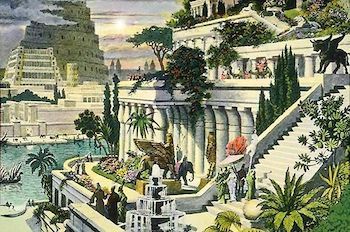
The most enduring image of the city is the Hanging Gardens of Babylon, one of the Seven Wonders of the Ancient World. The story of behind the gardens is one rooted in love. King Nebuchadnezzar II, the most famous ruler of the Neo-Babylonian Empire, is said to have built the gardens as a gift to his homesick wife, Amytis, who longed for the green hills of her homeland. It’s still not certain if the Hanging Gardens existed, as no current archaeological evidence has been found. However, the story behind the gardens has become a testament to love and sacrifice, a theme reflected in the modern art landscape.
Babylon In Entertainment
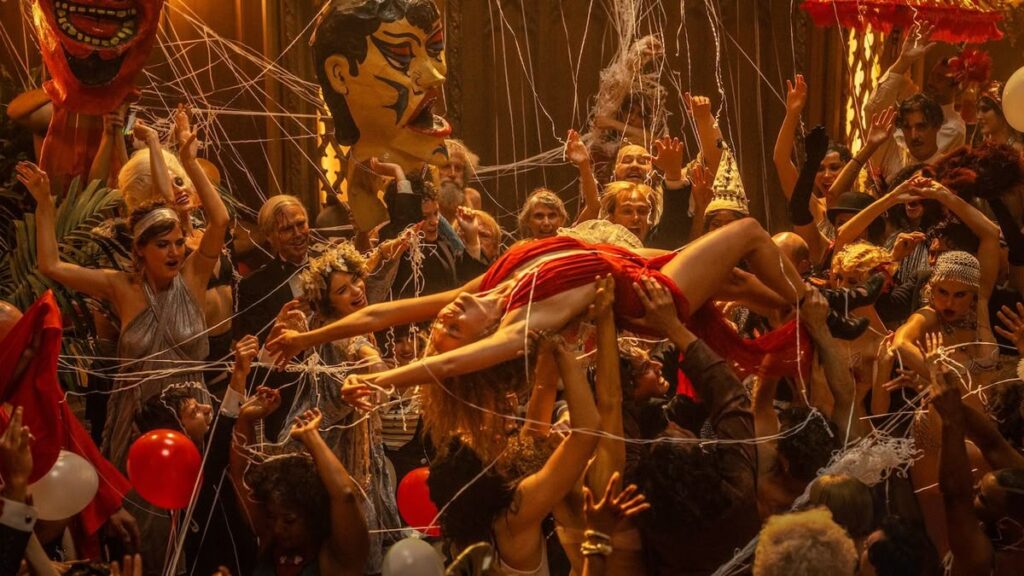
In Damien Chazelle’s 2022 film “Babylon,” starring Brad Pitt and Margot Robbie, Hollywood becomes its own ancient empire. The movie tells the story of the debauchery and chaos of the Hollywood scene in the 1920s. The film follows the rise and fall of multiple characters who become consumed by the Hollywood lifestyle of excess and desire for fame. The title itself serves as a deliberate reference to the fallen city, suggesting that Babylon’s downfall symbolizes humanity’s recurring and innate impulse toward self-sabotage.
Even in “The Matrix,” the story draws subtle ties to Babylon. The character Morpheus captains a hovercraft named the Nebuchadnezzar, which is a direct reference to King Nebuchadnezzar II of the Neo-Babylonian Empire, known for both his power and the Hanging Gardens. In the film, Zion, the last human city, is the antithesis of what is interpreted as the “modern Babylon,” as it is the only place of purity in a world corrupted by machines. These references form an allegory for how civilizations built on illusion and control will eventually be the ones to turn their beauty into dust.
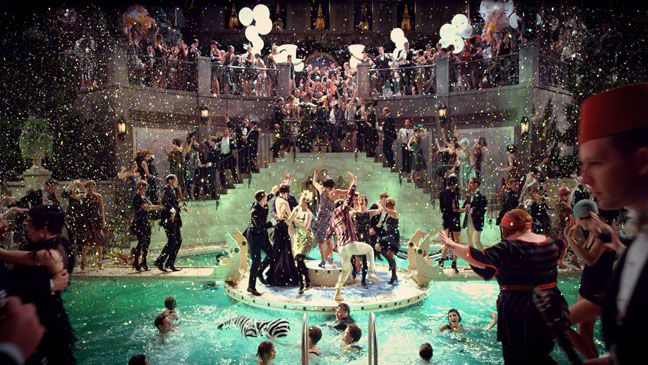
Baz Luhrmann’s “The Great Gatsby” offers another vision of a “modern Babylon,” this time set in New York City. Gatsby is the film’s modern Tower of Babel builder, striving to reach something divine — be it love or status — through human-made means. His glittering mansion is his tower, and Daisy Buchanan, his heaven. If he can just get close enough, he believes he can remake the world as he wants it to be. However, just as the biblical Babylon falls, Gatsby’s dream collapses. The same wealth and glamour that sustained him also destroyed him.
Taylor Swift’s album “Evermore” features the song “Cowboy Like Me,” which includes a lyric: “Now you hang from my lips like the Gardens of Babylon, with your boots beneath my bed forever is the sweetest con.” Here, Babylon becomes a metaphor for love’s illusion, how something magnificent and seemingly eternal can be so deeply uncertain. Just as historians still debate whether the Hanging Gardens ever truly existed, Swift questions whether a love that felt real was ever more than a beautiful myth.
We can contemplate where we have built a Babylon in our own lives. Asking ourselves the questions about what we built, whether that be our habits or the people we surround ourselves with, that at any moment is ready to fall.
In the same way, we can look inward and ask where we’ve built our own Babylons. Whether it be the towers, habits, or relationships we construct that will inevitably fall. Babylon’s story, retold through art, reminds us that even the most dazzling and lush creations can crumble; however, we can still find beauty in the ruins they leave behind.
What’s your Babylon? Let us know by tagging us @VALLEYmag on X!



Hi there! This post couldn’t be written any better! Reading through this post reminds me of my previous room mate! He always kept talking about this. I will forward this article to him. Pretty sure he will have a good read. Thank you for sharing!
It¦s actually a nice and helpful piece of info. I¦m happy that you shared this useful information with us. Please stay us up to date like this. Thank you for sharing.
Woh I like your blog posts, saved to fav! .
I was reading through some of your content on this internet site and I believe this web site is really informative ! Keep posting.
I like this web site because so much useful stuff on here : D.
Just about all of whatever you point out happens to be astonishingly precise and that makes me ponder the reason why I had not looked at this with this light before. This particular piece truly did turn the light on for me personally as far as this particular topic goes. Nonetheless at this time there is actually one particular position I am not really too cozy with so whilst I attempt to reconcile that with the main theme of the point, let me observe what the rest of your readers have to say.Very well done.