Long have American women been told what to feel about our bodies. In what ways we should hack and saw at ourselves—physically and mentally—to fit into the arbitrary confines of mainstream beauty standards. We have endured the politicization of the female body, the iconization of an unachievable “perfect” and have been taught to memorize the wrinkles and intricacies of our skin more than we have ever been encouraged to appreciate those of our brain.
Well, it seems that the sun is setting once again on the age of policing the female figure and diet. Though unlike movements of the past decade that have focused still on the appearance of the female body and have emphasized the notion that all bodies are beautiful, this new era welcomes a kind of inconspicuous neutrality that might just be what will pull us out the trenches of the obsession with our own reflections. Instead of manipulating their bodies, women have taken on the responsibility of manipulating the narrative.
The story of American female liberation has persistently been co-opted by those without our best interests in mind. Our own stories and struggles have been chewed up and spat back out to us in the form of something that can be bought. News flash, salvation is not hiding behind a paywall! Ladies, we get to write this story! And the title of this chapter, you ask?: “We’re not stressin’.’”
How did we get here?
Since the advent of the idea of the nuclear family, women have been characterized as the planners and organizers of the home, this idea historically manifesting most principally in the kitchen. Similarly to how you can count on a baby being born approximately every nine seconds in the U.S., at any given point in the day, if you were to say out loud, “Mom, what’s for dinner?” your mock question would surely coincide with an all-too-real probing inquiry in the home of innumerable Americans. No one is more well-informed about the contents of a meal than the person who prepares it.
Specifically amidst the Great Depression, when the average American family was fraught with uncertainty regarding employment, housing and notably food, there was an emphasis on nutrient density in meals. As meal sizes were shrinking, families had to ensure that they were optimizing the nutritional potential of each and every meal. For those tasked with preparing the meals for the family each day, this meant knowing the contents of a nutrition label as well as knowing the back of one’s hand.
As body trends have changed over time, women’s cognizance of the details of what we are putting in our bodies has, for the most part, stayed the same, much to our own detriment. One thing that has persisted through the changing trends in female bodies is the lack of freedom that women have felt in relation to their bodies. Every few years there is a new box in which women are expected to fit, and one’s failure to do so leaves them vulnerable and unprotected from scrutiny. Women have historically lacked freedom when it comes to food, the predominant culture being one that views food as a means of control.
The ever-swinging pendulum
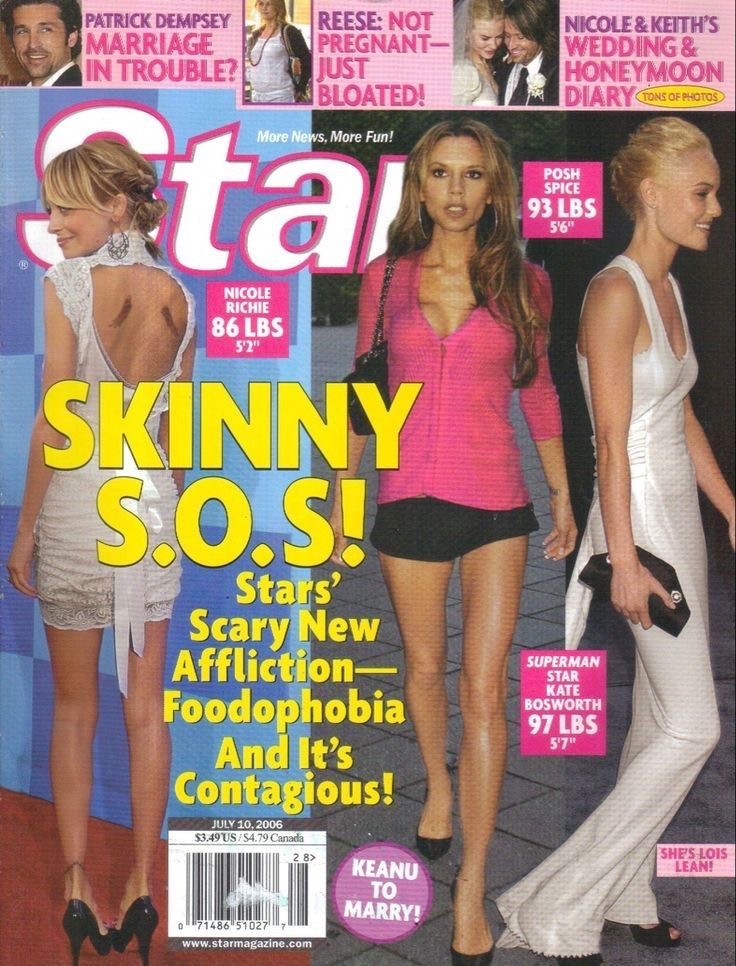
Specifically, the 90’s and 2000’s saw some of the most hostile messaging regarding women’s bodies. Arguably, the height of celebrity culture in the United States, tabloids relentlessly exploited the female body for engagement and profit. Everyday a new female public figure was plastered on the cover of a magazine, the headline undoubtedly something disparaging. Though in the mid to late 2010’s there was a shift. For the first time in a long time, magazines and other facets of popular culture began to feature a more diverse range of body types as subjects and muses, and the body positivity movement was in full swing. From 2014 to 2020, Meghan Trainor was singing, “All About That Bass,” Lizzo gained popularity as a new artist and outspoken voice of the movement and Precious Lee made history as the first Black curve model to appear in American Vogue. In the span of just a few years, it seemed that the restrictive culture of the prior decades had been turned on its head.
Directly following the height of the COVID-19 pandemic, the pendulum evidently swung back. Colloquially referred to as SkinnyTok, a new generation of influencers propagating ideas of highly restrictive portion control and over-exercising gained popularity. Today, though still prevalent, SkinnyTok’s predominance has subsided, making room for creators like Courtney Cook and the Fat Sunday girls to take the spotlight.
The era of “we’re not stressin”
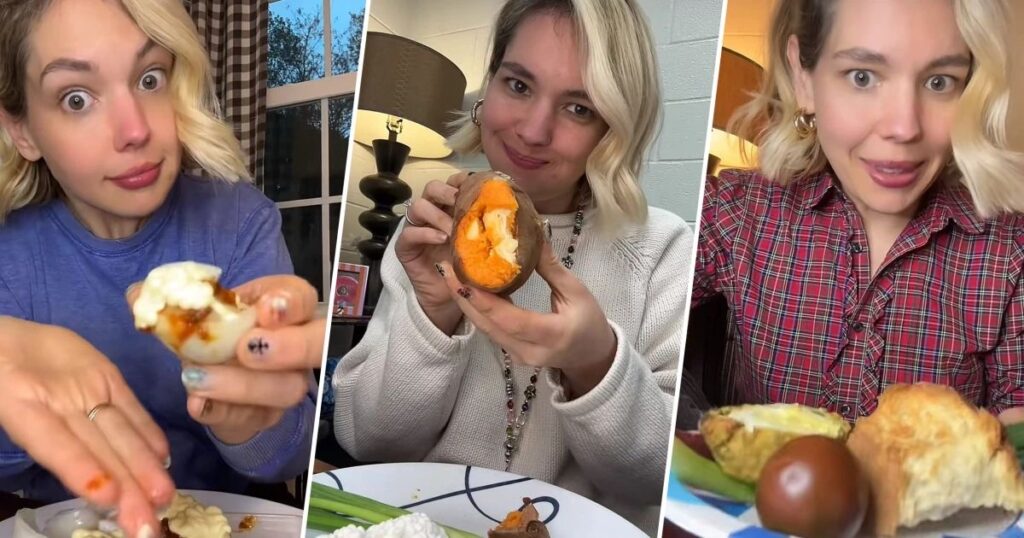
Courtney Cook is a high school English teacher from Fayetteville, Georgia, who gained popularity on TikTok in late 2025 for sharing her teacher lunches. Differing from the typical model of “mukbang” content, Cook speaks throughout the entirety of her videos, as opposed to simply eating. Possibly more than the food she shares, viewers have been captivated by Cook as a person; onion cups and soup dumplings are enthralling, but her personality is even more so.
More than anything, Cook speaks with pure enthusiasm about the food she is eating, and notably does not make mention of calories or whether she deems specific foods to be “good” or “bad,” simply because she’s “not stressin’.” Her “we’re not stressin’” catchphrase has become her trademark. It effortlessly encapsulates her philosophy surrounding food: she is not stressing! She is having fun while eating and she is making it look oh so easy. She makes every meal she eats look like the best meal ever, and she always seems so genuinely excited about it.
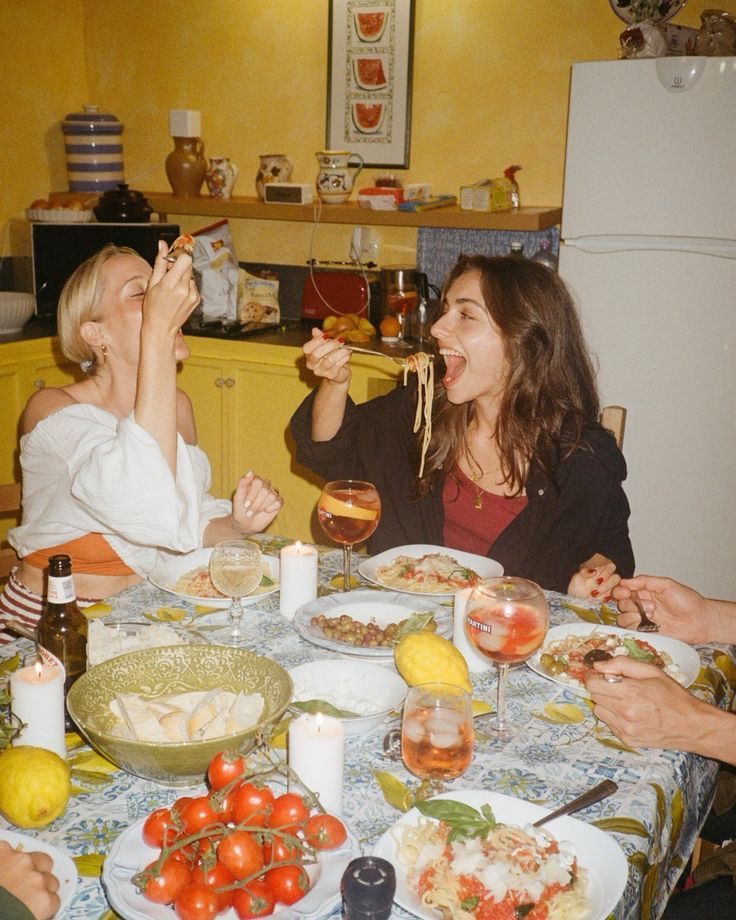
Similarly, the Fat Sunday girls of TikTok — best friends and New York City residents — have recently gained massive popularity from posting their so-called “fat Sunday” vlogs, where they document all of the food they eat and places they go on Sunday mornings following a Saturday night out. Chrissy — @cinnamonpoptartttt — and Maya — @babytunechii — are the figureheads of this trend. The girls document themselves and their friend group galavanting around the city going from coffee shop to bagel shop to sit-down brunch spots to burger joints, all together, all on Sunday.
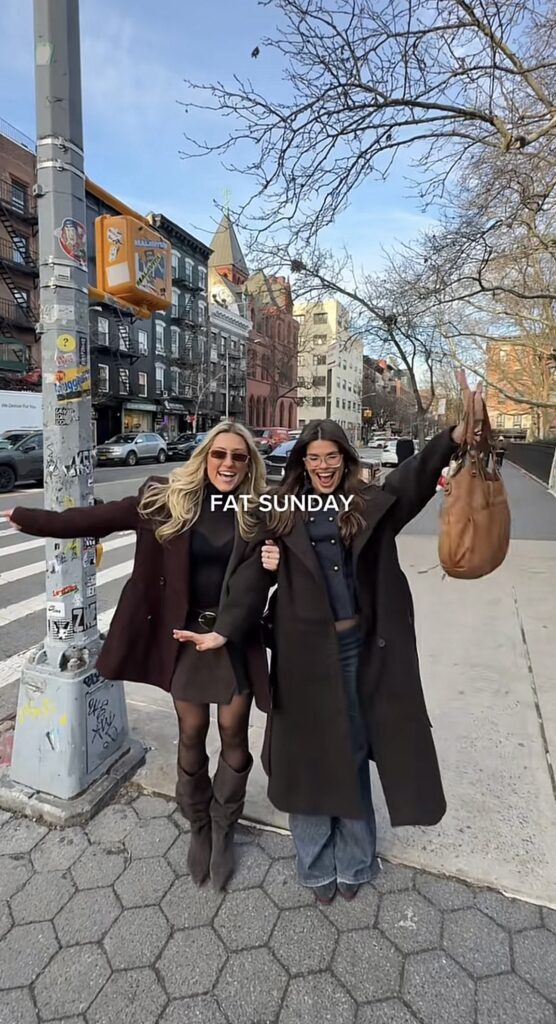
It is a well-known truth that one of the only things as fun as going out with your friends on a Saturday night is getting to debrief over brunch on Sunday morning, and these girls know it. The series reminds us that we are truly better together, as part of the fun comes from getting to watch their friend group enjoy each other’s company. Shamelessly eating to your heart’s desire may seem daunting to do alone, but ladies like Chrissy and Maya make it look like so much fun when doing it with their friends.
This page of the story of American women’s relationship with food is all about being free and shameless in our consumption. The girls are eating, and having fun while doing it. They are not taking a stand, or making a definitive statement about the state of female bodies or female liberation in America, they are simply existing in that grey area of neutrality, which lends itself to being resistant to assimilation to mainstream commercial media. You cannot sell us neutrality.
The mainstream media profits off of polarizing opinions and the sensationalization of political movements, but this new era isn’t asking us to pick sides—to be loud and take a stand. It is almost not a movement at all. It is something of an anti-movement. It is amorphous, and that is what makes it extraordinary. This specific game is ever-changing, and the ball remains perpetually in our court. It does not take on an identifiable shape, much less does it have a discernible manifesto. This “anti-movement” wills us not to make protests of our own bodies, but rather dares us to merely be.
While on the topic, what are some of your favorite “Fat Sunday” spots in State College for the morning after a night out? Let us know @VALLEYmag on X!